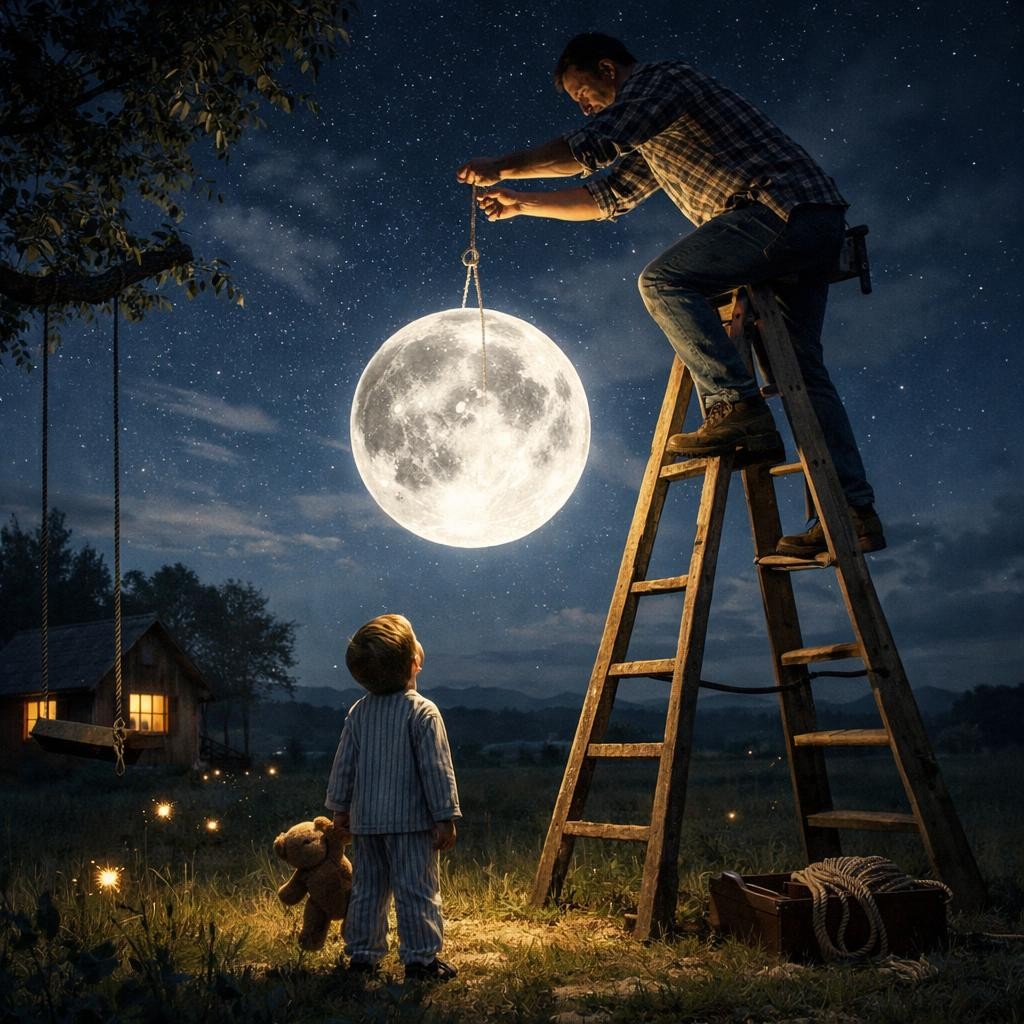
I started writing this post about New Year’s resolutions… In January.
Then I stopped. Then I stopped doing a lot of things — this blog included. I set out in January to build on an already strong foundation, and somewhere along the way I demanded so much of myself that I just… shut down. The ambitious January version of me, full of intentions and momentum, was running on fumes by March.
Classic. Typical. A cycle I know well.
It took burning out to realize what I was actually doing. With a little help from some Tony Robbins material, it clicked: I was trying to earn things I already have. Unconditional love. Support. Security. A son who thinks I hung the moon. I have everything I need — right here, right now — and I was burying myself in so much noise I couldn’t see it.
That’s not a motivation problem. That’s a perception problem.
I had convinced myself with these stories and beliefs. That I wasn’t enough. I needed to do more. I needed to BE more.
So I stopped trying to accomplish everything. I put the list down. And I went a little deeper into a few things that were already right in front of me.
He’s Watching
My son is at the age where he follows me everywhere.
He says the words I say. He watches me do things around the house and tries to help. He’s my little buddy, shadowing me through the most mundane chores — carrying things that are too heavy for him, handing me tools he doesn’t know the names of, just wanting to be part of whatever I’m doing.
And somewhere in the middle of all of that, it hit me.
I’m not the only one in this equation.
Every time I step into a gray area. Every time I say something I don’t mean, think poorly of someone, try to bail on a commitment — I picture him watching. I think about the man he’s going to become, and I think about the role I’m playing in that. Not the big dramatic moments. The quiet ones. The Tuesday morning ones. The ones nobody sees but him.
Ryan Holiday put it better than I could in Daily Dad:
“Our kids are whom we should want to impress. They’re the ones we should never want to let down. They’re not only the ones we’re fighting for but also the ones whose standards — whose natural admiration and love — we should always be fighting to live up to.”
When he asks me, “Daddy, what doing?” — I want to have a worthwhile answer.
That’s the deeper why.
The External Fix That Isn’t
Here’s the trap I keep falling into: the belief that making external changes — buying something new, rearranging my surroundings, starting a new system — is going to somehow make things better.
It doesn’t. It never does. Not on its own.
I’m still, in some ways, the kid looking at adults thinking they had it all figured out. Still waiting for that feeling to arrive. Still building the version of myself I always assumed I’d just become at some point.
The difference now is I know it doesn’t just arrive. You build it. Deliberately. In the small choices, the daily habits, the moments nobody’s grading.
Going Within
The page is dog-eared. Highlighted. Underlined. Meditations 4:3:
“People try to get away from it all — to the country, to the beach, to the mountains. You always wish that you could too. Which is idiotic: you can get away from it anytime you like. By going within.”
He goes on:
“Nowhere you can go is more peaceful — more free of interruptions — than your own soul.”
This is why I meditate. Not because it’s trendy. Not because some podcast told me to. Though the Tim Ferriss Show and Tools of Titans bring up meditation quite a lot — but anyway — for 10 or 20 minutes a day, I can simply exist in the moment. Everything else fades. Nothing is broken. Nothing needs fixing. I know peace.
Marcus also gives you a checklist for when you’re spiraling — people’s behavior, the things the world assigns you, your body, your reputation. He walks through each one and essentially says: none of this has any hold on your soul unless you give it permission.
Unless YOU give it permission.
“Things have no hold on the soul. They stand there unmoving, outside it. Disturbance comes only from within our own perceptions.”
I love that line. When something is happening, or when someone is intending to bother me, a little ping goes off — my internal monologue says, “There it is, outside of you.” A gut-feeling flag I try to trust before reacting. My inner peace, my purpose, my love for my son — none of it can be touched from the outside unless I let it.
The Only Opinion That Matters
The second passage that stuck with me was shorter. Meditations 4:18:
“The tranquility that comes when you stop caring what they say. Or think, or do. Only what you do. Is it fair? Is it the right thing to do?”
What other people think about how I’m living my life is none of my business.
If I’m showing up for my son. If I’m doing the work. If I’m living with some measure of integrity and intention — that’s the standard. Not the opinions. Not the applause. Not the eye rolls.
Life on life’s terms. Things will happen regardless of my reaction to them. The only question is whether I let them pull me off course.
The Real Resolution
So yes — I want to get in better shape. Spend money more wisely. Build better habits. All of it still matters.
But the underlying why is clearer now than it’s ever been.
I’m not trying to earn what I already have. I’m trying to be worthy of it — every day, in the small moments, in the choices nobody’s watching. Except him.
I want to earn those big hugs. I want to deserve those wide, amazed eyes. I want to be the kind of man my son looks at and thinks, that’s what it looks like.
In the summer of 2024, I started experimenting. Journaling, meditation, daily readings — just a few of the things that actually stuck. My mornings began with walks, cold showers, drawing sessions, and pre-caffeine workouts. I had no idea at the time how much I was going to need them.
Finding something I could consistently stick to took time. At its worst, the routine ballooned into an unwieldy two-hour marathon that was impossible to complete around morning responsibilities. I tried condensing it to a quick 15-minute essentials version. Eventually, I found balance.
2025 tested that balance in just about every way it could.
Shoulder surgery.
Cartilage issues in my knee.
A fall at my construction job that cracked a few ribs.
I managed about four or five weeks the entire year without some kind of physical limitation. The invincibility of youth is beginning to wear off, and my perspective is shifting with it.
Without my routine — or what was left of it — I would have felt like living was pointless. Just laying around, zoning out on streaming services, enjoying the buzz of an opioid. I needed something to give me purpose. I’m glad it was already in place before any of that started.
Doing what I could with a sling on my writing arm, I still read and reflected. I had to skip cold showers and cold plunges, but I could still meditate. I missed full-body workouts but stayed consistent with leg and core movements — anything the doctor or physical therapist approved. Those routines pulled me through. They kept me steady when I had nothing else to hold onto.
I built the road in 2024. I just didn’t know I’d need it so badly in 2025.
The Word Nerd and His Dictionary
I keep one dictionary on my desk and one on the nightstand. Old habit that turned into something I can’t shake.
When I discovered etymonline.com — a long-term, human-entered etymology database created by Douglas Harper — I lost hours in it. If this word meant that, then what did that mean? Where did that come from? One word leads to another, leads to another, leads to an hour gone and a page of notes you didn’t plan on taking.
My wife calls me a word nerd. She’s not wrong.
So naturally, when I started thinking seriously about routines, I went to the dictionary first.
Routine — 1670s, from French routine, “usual course of action, beaten path,” from route, “way, path, course.”
Route — c. 1200, from Old French rute, from Latin rupta via — “a road opened by force,” broken or cut through a forest.
A routine is a path you’ve already broken open. You don’t have to fight through the brush every morning. You just walk the road you built.
I built mine in 2024. In 2025, it carried me.
The First Hour
Here’s what my morning looks like when it’s working:
Early wake-up. I wake naturally between 4 and 5 a.m., with a 5:10 alarm as backup. I love the quiet before everyone else is up. It’s my time.
Cold shower. I start warm, then go full cold. I stand in it until my breathing levels out and the adrenaline spike settles. Who needs coffee?
Gratitude practice. Three things — unique things. I don’t allow myself to write my wife, my son, or my dogs. It has to bring up a sincere feeling. The searching is the practice. It trains you to look for silver linings throughout the rest of the day.
Meditation. Ten to twenty minutes with a guided app, or just silence.
Daily readings.Daily Dad by Ryan Holiday, to start the day focused on my son. Then a passage from Marcus Aurelius — Gregory Hayes translation — where I read, reflect, and take notes on whatever comes up.
Journaling. At least one page in my A5 journal. Reflection, brainstorming, talking out a problem, or just clearing the mental clutter. Whatever I’m in the mood for.
That fills about an hour if I’m focused — closer to an hour and a half if I let myself breathe through it. After that, first caffeine of the day, then family and work.
I’m nothing without it. If I skip it, something feels off for the rest of the day. My new baseline is starting centered and grounded, and all of that comes from spending the first hour on myself.
Each piece matters for different reasons, but together they do one thing: they make me feel like I’m starting from a firm foundation, ready for whatever the day brings.
A Road Opened by Force
Marcus Aurelius wrote: “The impediment to action advances action. What stands in the way becomes the way.”
Ryan Holiday turned that idea into a book — The Obstacle Is the Way — and it’s one I keep coming back to. The Stoics believed that resistance wasn’t something to be avoided. It was the point. The friction is what builds you.
Think about that Latin root again. Rupta via. A road opened by force. Broken through. Cleared by pushing against Resistance until it gave way.
That’s what 2025 was. A year of obstacles — physical, mental, relentless. And every morning I showed up to my routine anyway, even a stripped-down version of it, I was doing exactly what the Stoics described. I was forcing the road open. I was making the obstacle the way.
The injuries didn’t interrupt the routine. In a strange way, they became the routine. Adapting, showing up, doing what I could with what I had — that was the practice.
I built the road in 2024. In 2025, I learned what it was made of.
What does your morning look like? I’d love to hear what’s working for you in the comments.
This post is part of the Back Roads — Built, Not Born series.
The Deeper Why — Post 2 — Fatherhood, Stoicism, and the reason behind the routine
The 90-Second Rule — Post 3 — Coming Soon — What science says about emotions, and how I use it
We rush, never seeming to have enough time in our days. If we aren’t occupied with an ever-growing to-do list, it can feel as if we aren’t accomplishing anything. Time ticks by as we stare at screens. Taking a phone call or traveling for a work meeting can also mean you’ve missed an important event. Or worse, we lose or kill time as we clear a few more levels in Candy Crush just to rush around to make it up later.
First, I think of the stoic philosopher Seneca the Younger, a favorite quote of mine,
“You live as if you were destined to live forever, no thought of frailty ever enters your head, of how much time has already gone by, you take no heed. You squander time as if you drew from a full and abundant supply, though all the while that day which you bestow on some person or thing is perhaps your last.” (Seneca)
Then I glance up at the advice Robert Greene gave Ryan Holiday,
“He told me there are two types of time: alive time and dead time. One is when you sit around, when you wait until things happen to you. The other is when you are in control, when you make every second count, when you are learning and improving and growing. Which one will you choose?” (Holiday).
These reflections bring me back 10 years to a construction site where the owner of DC Building scrawled,
“Lost time is never found… DON’T WASTE IT”
on the inside of the tool trailer door for all to see. The years I spent on that project taught me more about efficiency than construction.
My own relationship with time is complicated by more than a decade lost to drugs and alcohol. I catch myself packing my days so full that I can’t stand it as if I’m paying off some temporal debt to the universe. As if I must live with double the effort and meaning now because I squandered so much in hedonistic pursuits. Continually reminding myself that the time wasn’t lost, it was a learning experience that already adds meaning to my present.
I don’t like sitting still. Doing nothing is either a deliberate act or a response to exhaustion. The thoughts normally go something like this:
I need to take a break for a bit. I’ll eat lunch and watch a quick show on Netflix. Then back to it.
I rarely make it through a half-hour show. I eat while I cook, never pausing to taste the food or really watch the TV. I often just listen to podcasts during this time to make it more efficient. About 15 minutes after my “break,” I’m back on task.
I rarely make it through a half-hour show. I eat while I cook, never pausing to taste the food or really watch the TV. I often just listen to podcasts during this time to make it more efficient. About 15 minutes after my “break,” I’m back on task.
Time Related Rules I Live By
I get annoyed waiting on people; if you are 5 minutes early, you’re 10 minutes late. If you tell me you’re going to show up at a specific time and are late, it’s YOUR character flaw and means you don’t respect me.
It’s totally fine if I have to wait because I show up early, though. I take advantage of that time with quick meditation or reading the book I’ve kept handy.
I don’t set casual meeting times; “around 5” or “this evening” doesn’t fly. I demand a time or don’t schedule the meeting.
I have very little patience for indecision; I set my meals, clothing, and brands so I can avoid decision fatigue and the lost time it brings. When I don’t know what to wear, say, for an appointment. I’ll add 10 minutes to the mental clock I’m rushing against.
I’ll plan to try a new dish out on Saturday. I make that plan Monday morning.
People don’t seem to understand why I’m always operating with a baseline level of stress, and I don’t seem to understand why everyone else isn’t. It’s not maintainable, it’s not healthy in my relationships, and it needs to change.
What to do about it.
I’ve read and applied philosophical texts to anger issues with some success in the past; I figured I should apply the same framework to my relationship with Time. I’ve read a bunch of nonfiction on how to get more out of my days, such as Cal Newport’s Deep Work, a fantastic book about using time as a tool. I wanted to understand my relationship with time better, not so much how to utilize it. So, I started with Eva Hoffman’s aptly named Time. A philosophical exploration of time and the body, the mind, its cultural significances, and the last chapter, Time In Our Time.
Towards the end of the book, but a good beginning for a blog series, I found an interesting passage about the Greek deity Chronos. It reads, “…trying to achieve temporal omnipotence is a losing game. In Greek mythology, Chronos is the first of all the gods, creating order out of chaos but capable also of eating his own children.” (Hoffman). This seems like a great lesson: time can consume your children’s childhood before you realize it’s gone, as you toil away your life in worldly pursuits. The moral of the story carries an air of ancient wisdom.
First things first, let’s go to Google! I found a ton of conflicting information from secondary sources, none of which satisfied my curiosity. So I decided my first mission was to sort out the origin story of Father Time. If Chronos created chronological time out of primordial chaos, “Father Time” is as good a moniker to hang on him as any.
According to Wikipedia, Eva Hoffman holds a Ph.D. from Harvard in American Literature, has written several books, and has an impressive academic career. There was no notation besides her entry about Chronos, so nothing came up in the note section either. I’m just going to assume the handful of sentences dedicated to him in passing we’re either decided to be common knowledge, or added effort wasn’t spent, because Chronos really isn’t the subject of the chapter or a main theme in the book. I’ll have to satisfy my own curiosity.
I came across conflicting names: Cronus, Chronos, Kronos. Then, different versions of the origin story than Dr Hoffman’s. Some articles state there were totally different gods with similar names. The pantheon of Greek gods is already confusing enough, and then I found Roman mythology mixed in as well. It can get out there. I decided to step away from general Google searches and log in to my ASU library pass. Hoping scholarly sources will help me sort this out a little better.
What I found first was an explanation of why things were so fragmented and mixed up. For one, Chronos had no real religious following. Maybe a small cult here and there, but for the most part, he wasn’t a routinely worshipped deity, so there’s not a ton of information in writing about him that survived.
I also found a quote from the guy who questioned everything to a point that relentlessly questioning things is now called the Socratic Method. Socrates had this to say about the pantheons in general,
“Now, whether there is one Aphrodite or two, Celestial and Popular, I do not know; even Zeus, though considered one and the same, yet has many names.” (Xenophon).
That doesn’t strike me as a question. That is more of a palms up, shoulders shrugged, resignation from a great mind with significantly more contemporary context than me.
WHAT AM I GETTING MYSELF INTO?
Enter ’Interpretatio Romana’
“…a phrase used to describe the Roman habit of replacing the name of a foreign deity with that of a Roman deity considered somehow comparable.” (Rives).
There is no definitive summary or hierarchy of the gods. As the Romans traveled, conquering and incorporating other Mediterranean cultures into their empire, they absorbed them into their own. Similar gods were joined together; be it similar by spelling, imagined appearance, ability, or anything goes as long as it goes together.
Most of these cultures shared a common ethnicity and pagan pantheons, so it was probably the path of least resistance to see how they fit together. Someone had to be mostly right… Right?
Back To Our Protagonist
In a drama-filled story fit for modern reality television, Chronos was not only powerful and knowing enough to create order out of chaos, but he also consumed his own children. I’ve decided to refer to him as Chronos from here on, so we’re all on the same page as I piece together the story from multiple sources.
Chronos was the last of the 12 Titan children of Uranus (Sky God) and Gaia (Earth Goddess). Uranus hated his children and banished them to a particularly nasty section of the underworld called Tartarus, causing Gaia to have her last child in secret. The plot to overthrow Uranus ended with Chronos castrating his father with a sickle and throwing his dismembered member into the sea, thereby creating more deities. He then freed his brothers and sisters, and they saw him as their leader.
A prophecy foretells that Chronos will suffer the same fate as his father, at the hands of one of his own children. To prevent this, he ate his children as his wife, Rhea, gave birth to them. These children are the pantheon of gods we’re familiar with from Disney’s “Hercules.” Rhea, to save her youngest child, tricked Chronos by swaddling a baby-sized stone, which an unwitting Chronos consumes, believing it was Zeus.
As Zeus grew, he and Thea plotted to free his siblings. When Zeus reached adulthood, he castrated his father and forced him to vomit up his family. (Encyclopedia of Time).
We Have Some Time For More Back And Forth
In Mitoloji Sözlüğü (Mythology Dictionary) Azra Erhat makes a point on the etymology of Cronus, stating that the name Cronus is not connected to the Greek word chronos (χρόνος), which means “time”. This challenges a common interpretation found in later Greek myths and among contemporary scholars.
I found no sources in my research that connected the deity to “creating chronological time from chaos.”
Plutarch used examples from Cicero’s writing, where he writes of Cronus and Chronos as equals by extension. He begins to reference Cronus as the father of time.
Cicero wrote, “By Saturn, again they denoted that being who maintains the course and revolution of seasons and periods of time, the deity actually so designated in Greek, for Saturn’s Greek name is Kronos, which is the same as Chronos, a space of time. The Latin designation ‘Saturn’, on the other hand, is due to the fact that he is ‘saturated’ or satiated with years” (Cicero).
Later Greeks then begin to read Cronus as Chronos, and it become Father Time and the sickle at some point. They also depicted him with a crow, which was an oracle understood to house the soul of a king after sacrifice. (Graves)
Approximate Time & Dates For Some Of These References
Plutarch was alive from approx. 46 to 120 CE.
Cicero lived from 106 to 43 BCE.
Socrates was executed in 399 BCE.
Some of the earliest written evidence of Cronus appeared in the 6th and 7th centuries also in Pindar’s poetry around 500 BCE.
In Conclusion
In summary, it’s no wonder we have a complicated relationship with time. It has been a mess from the start… a long time ago. Some of our oldest gods, most renouned philosophers and poets can make sense of it. It seems that if you don’t get your time management under control, it can not only consume your life and your children, but it can also compromise your decision-making and sanity. It will make you jealous and paranoid, or at the very least it will definitely add chaos to your sense of chronological time.
Time has implications in our day-to-day life, but also spreads out in cyclical [attention over longer spans. Does it repeat itself? Who are we in relation to it? Is there an overall story arc or outline that we’re following? Do we go through the same patterns as other mammals, trees, and civilizations? Why can’t I go to the gym AND make it to work on time?
I’m going to explore time, with you, topic by topic, that I find interesting and hopefully find some greater depth and understanding of my, our, relationship with it.
If there’s anything in particular, you’d like me to explore, research, or write about, post below. Also, feel free to leave feedback!
Bibliography
Cicero. De Natura Deorum. Translated by H. Rackham, Harvard University Press, 1933.
Sitting down to what I thought was writing was fun. It was easy; just a stream of conscious thought. The more emotional weight, the more people would love it. Chaotic meant raw, and people would understand that. I was making longer sentences and impressing with descriptors, creating one-off masterpieces. I was going straight to print and it was going to be wonderful. I was a writer. However, I soon realized the importance of writing more concisely.
Verb tense agreement. Who needs it?
Should every sentence move the narrative, develop character or revolve around conflict? Right after I finish this sentence.
An Oxford comma?
The first thing was realizing I wasn’t writing well. I was writing easily reduced nonsense. When reduced, I could see the flaws.
Why doesn’t this sound right?
This isn’t adding anything.
“…the adverb carries the same meaning as the verb (“smile happily.”)” (Zinsser)
Is it time for me to take accountability and face up to my wasteful, nonsensical ways? Or do I declutter?
The simple lesson lesson I learned:
Less Is More When It Comes To Writing More Concisely
To do anything well, I can’t be distracted by the unnecessary and unrelated. This leads to writing even more nonsense. It feeds on itself.
Do I have an outline?
Is the work moving forward?
Submitting what I knew was an A on a project titled ‘Writing to Locate.’ I could not have been more deflated when I saw the graded draft. I jumped to writing whatever came to mind and turned in a “Powerful historical reflective written as a set of mini essays.”
The assignment: reflect on how a place has shaped and influenced me as a writer.
I poured my heart out. They didn’t get it. The laptop slammed shut, and I found somewhere else to be. When calm, I looked back over the assignment. I’d clung to bits of the instructions, and not the important ones. What I turned in was a journal-style series of riffs on a place that was personal to me—nothing like the examples they gave, and not on assignment.
Failing to read the instructions, I became distracted by my clutter. I piled more on. I then trimmed the excess – seeing the reduced version, I repurposed what I could, and threw out half of the 6-plus hours of work.
I realized, maybe I’m not so good at this. Research and practice are desperately needed. No matter how much I wanted to produce a masterpiece, I had no idea how the parts functioned. I’m awful at receiving feedback, and I couldn’t stay on topic. Feeling imposter syndrome setting in, or the less dramatic explanation: self-doubt. I felt I had failed all at once. Ready to quit, and live life the way I had previously. I’m good at watching TV, I should stick with that.
The final grade. I’m glad I refocused.
No, no, no! I won’t buckle to adversity so easily!
What I need is a plan. I love to read, which in turn makes me want to write. So why not read about writing? I listen to podcasts in the morning. Why not about writing? Why not repurpose the time to help me improve? It’s all so simple, I can’t look back without embarrassment at the amount of time spent convincing myself not to or I’d get to it later, when all I had to do was work to be better at it.
I studied aspects of my business life to become better at remodeling or writing contracts. I learned more that the average disc golfer about course design and flight turbulence. Why was I building walls around writing? Maybe not walls, more like hanging a no trespassing sign on a shabby gate. I was afraid of admitting how bad I was at it. No one is born good at writing, we all start from zero. Some of us just work harder at it than others. You must work at it to get better.
Time to set some goals.
Goal 1: More concise writing needs a better foundation.
Reading about Abraham Lincoln in Wisdom Takes Work. Ryan Holiday talks about how he used to copy books just to “feel” the work (Holiday). A technique called copy work. As part of my writing education, I will read books on grammar and style and type them as I read. Interacting with the material on several different levels.
One of my biggest issues is that I don’t know what I don’t know. Typing these polished sentences about writing, its parts, and assembling them can’t hurt. When Abe ran out of paper, he took to carving the words into wood (Holiday). Blocking out 30 minutes of my day for this should be easy.
Copy work: Chapter 5 The Audience from William Zinssers On Writing Well.
Goal 2: Writing practice. Study how others write concisely.
I can’t just copy others’ work; I need to produce my own. I can create one or two blog posts to apply what I learn and work through exercises. That, in addition to my daily journals and weekly schoolwork, is a lot of writing. I will settle into my own style while refining my process through productivity.
Goal 3: Embrace the process. I will write more concisely in time.
A shift in perspective will surely help. I cant take feedback so personally. I need to embrace mistake. That twinge of embarrassment is a cue to learn. Writing can be hard work. Writers make it seem like hard work, sharing stories of publisher rejections and transcripts filled with red ink from projects that consumed years of their lives. They find reward in the finished product and learn to love the process. My low-risk, low-reward feedback pales in comparison. I need to stop being so hard on myself and seek growth opportunities.
Goal 4: Learn by reduction. The more you subtract the more concise your writing becomes.
Declutter. The quality of writing will improve when I remove. It will be easier for the readers to understand when I don’t bury the subject under adverbs, prepositions, and adjectives. I will be ruthless with a red pen. When I remove, I will see the bones. How they fit, what could be done differently.
Looking at this reduction, hopefully a more nuanced understanding of sentence structures, and how to shape them will engage instead of confuse—more focus on moving the writing’s goals forward while carrying the reader with me.
Draft editing.I actually really enjoy using a red pen… Maybe I was born to be an editor?
Printing out the smaller projects gives me a physical difference in medium. I have a habit of editing and revising while drafting, which slows the process. Separating the process physically helps me focus on each task. Computer means I’m drafting. Paper means I’m editing. I then retype the document with corrections and make revisions when I’m done. Not the most efficient process, but I’m spending time with the different steps and refining my practice. This seems to be the best way for me.
These concepts are also thousands of years old. In the Gregory Hayes translation of Meditations, Marcus Aurielius advises, “…Don’t gussy up your thoughts. No surplus words or unnecessary actions…” (Hayes 3.5). Writing in his personal journal while he was emperor he could of used as many words as he liked. I’ll talk more about Marcus in another post. He’s my favorite of the stoics.
The time spent stubbornly learning the hard way is frustrating to quantify. Numerous resources are available, allowing us to avoid trial and error. I’ve been working with On Writing Well by William Zinsser for this stage of my practice. What resources have you found helpful in your writing practice? Whether it’s books, podcasts, courses, or workshops, I’d like to learn about your journey and perhaps discover something new for myself. Let me know in the comments!
Happy editing!
Works Cited
Hayes, Gregory. Meditations. United Kingdom: Penguin Random House LLC, 2002. Book.
To be a builder, you must build. To be a harpist, you must play the harp.
That’s my paraphrased version; here’s the actual quote:
“…the virtues we acquire by first exercising them, as is the case with all the arts, for it is by doing what we ought to do when we have learnt the arts that we learn the arts themselves; we become builders by building and harpists by playing the harp. Similarly it is by doing just acts that we become just, by doing temperate acts that we become temperate, by doing courageous acts that we become courageous.
In my life, I have always wanted to write. I can think back to at least 4 or 5 different attempts at writing ambitious novels or creative writing projects that ended in overwhelm and disappointment. I didn’t know what I was doing.
I’d tell myself, “I’ll make time for this later.”
The only thing that materialized was the “later” part. Nothing else. Pretending I’d get around to it later kept the goal locked in perpetual procrastination. Loading. Loading. Loading and never acting on it.
Drawing on a wide variety of experiences, I always felt as if I were doing what I was supposed to do. However, the baseline feeling of discontent always loomed. An ever-present yearning and aspiration for more stuck with me. Convincing myself that deeper immersion would supply purpose, I often find myself overcommitted and disinterested at the same time.
Life has been a journey of ups and mostly downs, arriving yet again at a period of reinvention. A familiar struggle of purpose and identity with an emotional coloring of frustration that I would prefer not to pass down to my son. I find myself trying different things, learning how to outline and structure a few businesses, studying philosophy, and reading as many books as I can. The feeling of contentment only comes when I write.
Journals, logs, papers, project outlines, notes, and shopping lists. I think in outlines and organization. I search for ways to make it sound and look appealing. I lose time reworking sentences and enjoy playing with the words and structure. It’s where I spend my free time. Pen to paper, fingers clacking away. I’m entranced by it. I’m proud of it when it’s done.
I want to be better at it.
Having never written for an audience other than work-related outlines or papers submitted to college professors, I’ve decided this would be a good place to start. As good a place as any.
I want to pull from my wide variety of experiences and chronicle my growth in one place for others to read. This blog offers a different writing perspective, allowing me to engage with an audience while sharing both my triumphs and failures. I aim to work through problems and present solutions I’ve discovered along the way.
This blog is not just about me; it’s an effort to understand who I’m becoming and to help others in the process as I figure out what that process looks like. I don’t believe my story is necessarily more unique or intriguing than anyone else’s. I don’t envision a million followers eagerly awaiting my next writing session. Instead, my goal is to share my journey, to document my growth, and to assist others on their paths as well.